

The Truth About Why You Really
Can’t Lean on Motivation
EP. 695 (Stuck series (2/2))
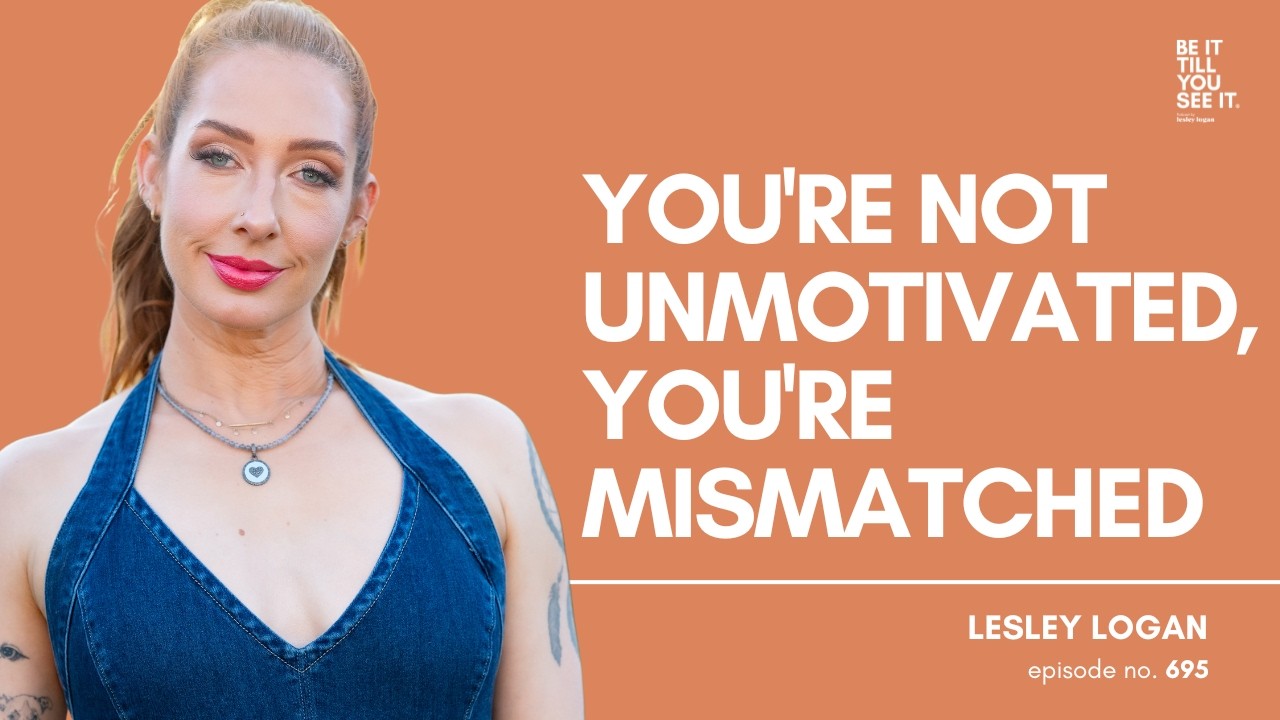
“Motivation is actually a fickle friend. “
Lesley Logan
Follow and subscribe for free



Bio
Click to read more about: Lesley Logan
Shownotes
In part two of the Stuck Series, Lesley Logan unpacks why feeling stuck rarely has anything to do with a lack of motivation and what’s really keeping you frozen. She breaks down how mismatched systems, unrealistic expectations, and unspoken fear quietly drain your energy, and offers a practical framework for moving forward. Find out how messy action, not motivation, is what finally gets you unstuck.
If you have any questions about this episode or want to get some of the resources we mentioned, head over to lesleylogan.co/podcast/. If you have any comments or questions about the Be It pod shoot us a message at [email protected].
And as always, if you’re enjoying the show please share it with someone who you think would enjoy it as well. It is your continued support that will help us continue to help others. Thank you so much! Never miss another show by subscribing at LesleyLogan.co/subscribe.
In this episode you will learn about:
-
The role outsourcing and systems play in getting unstuck.
-
How motivation is fickle and why you can’t rely on it.
-
Why mismatched expectations vs. reality requires a rebuild
-
Naming the fear underneath the freeze, plus building a backup plan.
-
Tactile tools: two-minute rule, friction reducers, and messy action.
Episode References/Links:
-
The Four Tendencies by Gretchen Rubin – https://a.co/d/0fgVJtiK
-
Tiny Habits by BJ Fogg – https://tinyhabits.com
-
Ep. 613 Habit Series 1 – https://beitpod.com/ep613
-
Ep. 614 Habit Series 2 – https://beitpod.com/ep614
-
Ep. 616 Habit Series 3 – https://beitpod.com/ep616
-
Ep. 617 Habit Series 4 – https://beitpod.com/ep617
-
Ep. 619 Habit Series 5 – https://beitpod.com/ep619
-
Ep. 620 Habit Series 6 – https://beitpod.com/620
-
Ep. 622 Habit Series 7 – https://beitpod.com/ep622
-
Ep. 623 Habit Series 8 – https://beitpod.com/623
-
Ep. 256 with Rory Vaden – https://beitpod.com/ep256
-
Ep. 688 Outgrowing Series 1 – https://beitpod.com/ep688
-
Ep. 689 Outgrowing Series 2 – https://beitpod.com/ep689
-
Ep. 93 with Jillian Flodstrom – https://beitpod.com/ep93
-
Ep. 589 with Brad Bizjack – https://beitpod.com/ep589
-
Cambodia Retreat Waitlist – https://crowsnestretreats.com
-
Submit your wins or questions – https://beitpod.com/questions
Transcript
Lesley Logan 0:00
Taking the action, taking an action that helps get you unstuck, is the antidote to fear, and it brings clarity. Action brings clarity. That’s the hardest thing about all of this, is we’re all waiting for motivation, or for us to just like wake up one day unstuck, but truthfully, we have to take a step, take some messy action to actually get unstuck.
—-
Lesley Logan 0:21
Welcome to the Be It Till You See It podcast where we talk about taking messy action, knowing that perfect is boring. I’m Lesley Logan, Pilates instructor and fitness business coach. I’ve trained thousands of people around the world and the number one thing I see stopping people from achieving anything is self-doubt. My friends, action brings clarity and it’s the antidote to fear. Each week, my guest will bring bold, executable, intrinsic and targeted steps that you can use to put yourself first and Be It Till You See It. It’s a practice, not a perfect. Let’s get started.
—-
Lesley Logan 1:04
Hi, Be It babe, welcome back. We’re back on our stuck series, so we’re getting unstuck today. So last episode we actually talked about what does feeling stuck actually feel like, and is it actually that we’re stuck? And we kind of realized that we’re not stuck, right? We might just be overwhelmed or lacking support or tools to get to where we want to go. We might have overwhelmed ourselves, or we might be putting pressure on ourselves, and that might be why we’re feeling this way. It might be like being a perfectionist again. Sometimes it sneaks back up on us, right? So, the one thing that I hear people say that they need when they’re feeling stuck is motivation, and we have to talk about motivation, because motivation is not the thing.
Lesley Logan 1:37
I used to think that I’m just a super motivated person. When I was younger, I was like, “Oh my god, if I said I was gonna do something, I do it,” right? And what you realize when you read The Four Tendencies book by Gretchen Rubin, you discover like, “Oh no, that’s just a tendency I have.” If I say I’m gonna do something, I do it, whereas other people need an accountability partner, or some people need to be able to make decisions. I’m gonna do what I said to do. So, as I got a little bit older and a bit in the stage of my life where I was running my businesses and there were things going on and I was struggling to do them, I thought, “Oh my god, I just need motivation to work on that.” And because of the ADHD brain, I was probably just seeking dopamine hits, and that’s how I was getting things done. As I worked on myself and got to know myself and stopped overwhelming and overloading myself with things to do, I actually just became a person who was, I don’t know, whelmed. It wasn’t motivation that I needed, but systems to help me continue to do the things that I said I wanted to do, and also with systems, making sure that I wasn’t saying yes to things just because they were cool.
Lesley Logan 2:41
So because I know me better, I have better boundaries, and because I understand how motivation works, I don’t actually wait for the motivation to do the things. I understand how to set myself up so I can take one step at a time, celebrate what I did do, and then go again the next day. I’m no longer a person who’s like, “I have to get my to-do list done every day,” because that pressure actually slows me down, and it makes me not feel like I’m me doing the thing, right? I’m not a patient person. So, in case you’re like, “Oh, I wish I was you,” I’m not a patient person. So, if I can do it, if I can take action on the things that I want to do, if I can help myself move the needle one millimeter forward in a day, you can do it too, right?
Lesley Logan 3:27
Because we don’t need motivation. And if you didn’t hear our episodes in December of 2025 about habits, where I talked about motivation as a very fickle girlfriend, and you can learn more about this in BJ Fogg’s book, Tiny Habits, but essentially motivation is needed when something is very difficult to get started. Like when you turn on a car, you have a starter, right? I think that’s what it is, and it helps get the car started. You also use more gas to get the car started, right? Planes are the same thing. And so you need motivation to get rolling, but then once you’re rolling, you don’t use as much gasoline, as much energy, or you don’t need those things, right? So, motivation is best to be used when something is a bigger deal, or is going to require more of us than we are used to, but then once we have gotten started, ideally we’re not waiting on motivation to just keep the ball rolling. That’s where systems come into place, right?
Lesley Logan 4:21
Motivation also is not something you can just go up, tap in, hit the motivation button, “I’m ready to go.” Motivation is actually a fickle friend. It’s kind of like my ADHD focus mode without Adderall. Yes, sometimes it hits, and I’m like, “Oh my god, I just got so much done,” but mostly it doesn’t ever hit at the time that I want it to hit. It’s not going to hit because something’s due tomorrow; it hits because of my ADHD, but it won’t hit like, “I want to do it now and not under pressure.” It doesn’t hit then, right? So I can’t wait for it. I talked about this in our habit series, motivation, you have to think of as like a really great friend that you go to parties with, but that you don’t actually rely on to pick you up at an airport to take you to an important meeting. You would never do that.
Lesley Logan 5:03
So, if the tasks that you are asking yourself to do don’t match your energy, you are likely doing things that do not bring you joy, and if they did before, they don’t now. Oftentimes we’re doing things that we think we should be able to do, or we think we have to do, or we don’t have the money to delegate it out, but just because you have done that before doesn’t mean you have to keep doing it. What I will just say is part of getting out of a rut is looking at the responsibilities you feel you are supposed to be the person to take those on and actually ask yourself, “Is this something that I need to be doing? Does this have to be done right now? Does it have to be done today?” Because it may be time to outsource some of the things that you need to happen in your life, so that you can have the time and energy to do what you said you wanted to do.
Lesley Logan 5:56
If you come on my retreats, oftentimes I’m like, “Hey, we can outsource. You can have groceries delivered. You can just save all your time driving to the grocery store, going up and down the aisles. You could just have them delivered. You can have a housekeeper clean your house, right, especially for the deep cleans.” But honestly, we have that every week. Why? Because one, I like a clean house, because I want to work in that environment, but I don’t like to clean the house. Because I don’t like to clean the house, it makes me exhausted when I do it, and then it’s done, I have this clean house now. Guess what? I don’t want to work in it because I’m exhausted. So the tasks that you have on your plate don’t match the energy, and then they’re draining you, and that makes you feel stuck. So you can come on a retreat with me in Cambodia to learn how to figure out what you should get off of your list, but if you don’t want to wait till that, I just want you to take a look.
Lesley Logan 6:43
What are all the things that you think you should be doing? Are there tools now that would make those things easier? Pick the one that you least want to do, you avoid doing, and that lives rent-free in space in your head, right? How can we get rid of it, or get someone else to support us on that? Your systems that you’re relying on often aren’t matching the brain that you operate with. I have ADHD, and in order to get my work done, I have support from a psychiatrist. So, I do take an Adderall, and when I take it, I actually can focus, and then I can actually use the tools that I have put in place to help me get my work done. I definitely can tell days when I have it versus when I don’t. I don’t take it on my days off, but I can tell that trying to do the things that I need to get done on a workday without it, I end the workday more exhausted and wondering, “Why do I do what I do? Am I doing the right thing? Am I aligned? Do I even love this job anymore?” because it took so much out of me to get it done than when I have the support that my brain requires, right?
Lesley Logan 7:46
But whether or not you have ADHD, the more you can understand how you think, how you operate, and have systems that match that, you know? If you are making to-do lists and never using them, then that’s not helping you. You need to figure out a different tool. If you are making the projects that you have to do on your to-do list so big “build a website” of course, you’re gonna feel stuck. That’s a humongous task that will not get crossed off for four to six weeks at least. So we have to figure out, what are the ways that you operate? How do you meet expectations? I mentioned it before, but Gretchen Rubin’s book, The Four Tendencies, is an excellent read. It helps you understand how do you meet the expectations you have, or that others have, and then when you know that, you can put systems in place.
Lesley Logan 8:24
For example, Brad is a rebel, and Brad will say, “Oh, I’m going to get up early tomorrow and do yoga.” Okay, but if I wake him up and go, “Hey, you wanted to get up early this morning and do yoga,” he will say, “No, I don’t want to do it,” because he wants to have choice. He must have choice, right? Because he’s a rebel, that’s how you meet the expectations. So, if I say, “Hey, babe, yesterday you had mentioned that you wanted to get up and do some yoga, so did you still want to do that, or did you want to sleep for a little longer?” When I present it to him like that, he always is like, “Oh, no, I’m going to do the yoga,” because he does want to do it, but he wants to have choice, right? If you’re an obliger, you are someone who needs accountability to get things done, so you need to find ways in your systems to have accountability to get things done, so you get them done. I’m an upholder, so if I said it I’m going to do it, which is also why if I say no to you, it’s not because I don’t love you, it’s because I know I won’t be able to get it done. I will never backtrack on an agreement, right? So if your systems don’t match how you operate, then you are going to get stuck and overwhelmed.
Lesley Logan 8:25
Okay, another way to get out of the rut is matching your expectations with reality, so you’re not unmotivated, you’re mismatched. Like if you have an expectation like, “Okay, tomorrow I’m gonna get up early. I know I’m not a morning person, but I’m gonna get up early, and I’m gonna go run two miles.” But one, you’re not a morning person, and you haven’t run in a year. You’re not doing those things, and that’s going to feel like, “Oh my god, I just wasn’t motivated.” No, you are not that person. You are not someone who wakes up early. You are not someone who runs.
Lesley Logan 9:57
So we actually have to make sure that the expectations that we have placed on ourselves actually match the reality of what systems we have in place today, right? So, if you’re like, “I want to make 10,000 a month with my business,” but you’re not even making 1,000 a month, those expectations don’t match reality. You actually have to first make 1,100, and 1,200, 2,000, and then 5,000. You can have the goal that “I want to make 10,000 a month,” but you can’t do it next month if you have never done it before, right? They don’t match reality, so you basically have put pressure on yourself and overwhelmed yourself, and put yourself in a stuck position. Versus if you took time to go, “Okay, what are some realistic expectations that I can place on myself that I can do this week, and then I could do tomorrow and I can do today?” working backwards, then you actually don’t need motivation; you’ll have broken things down in a way that allows you to get them done.
Lesley Logan 10:51
So, I will say, like the ADHD, we talked about this a moment ago, but yes, it has that super focus mode, but like the motivation, we can’t wait for it. So what I highly recommend to my ADHD people is you really can’t lean on motivation. You can’t wait for those focus modes. You have to learn your brain, and you have to learn the systems that help you. And there are some great experts out there. You know, Brad piles the mail all in this one place, so every day we pick up the mail, that’s a win for an ADHD couple, and we put it in a pile. We don’t put it anywhere, we put it in a pile, and then on Mondays he actually goes through it, right? That’s the system that works. I mean, you’d be surprised, I know you think you don’t operate well with systems, but when you get the systems that work for you, they work for you, and so it really helps you remain unstuck and not leaning on motivation or focus mode to help you like clean everything. Because what we know you’re gonna do is organize a cupboard and then not have cleaned anything, and now we have a messier kitchen. I know. Hello, I know me.
Lesley Logan 11:49
Fear is another real reason to feel stuck. So, if you’re listening to this because the outgoing episode really got your attention, you’ve outgrown an old version of yourself, but you’re feeling stuck right now because of fear, fear of loss, fear of responsibility, fear of failure. Right, that’s real. It’s real, and it’s important that we don’t diminish the fear that we have. If that is what the problem is, because anyone telling you there’s nothing to be afraid of, it’s not helpful, right? It’s like someone telling me like, “Calm down.” You’re like, “Do you want to see me calm down?” So, what I know about fear in the studies that I’ve done on it, the really important things that you can do is, one, call it out. What are you afraid of? What are you afraid is going to happen? If you don’t want to say it out loud, write it down. If you don’t know what it is, but you know there’s a fear there, then just keep writing until it comes out, right? What is this thing that I’m afraid is going to happen? “I’m afraid no one’s, everyone’s gonna… no one’s gonna like me.” No one is gonna like you. And then you’re like, “Why am I afraid about that? Why do I think that’s gonna happen?” right? Like, take some time to really understand why you have this fear, because if you can actually identify it, then we can create an exit strategy, right? A backup plan. Because the truth is that nothing ever is as bad as or as good as we want or fear. “Oh my god, if I do this thing, I’m gonna die.” Well, that’s not happening, because you just listened to this. “Oh my god, if this goes so well, I’m gonna have a million dollars.” Well, maybe you do, but most of the time we land somewhere on a spectrum, and so take some time to like really truly go, “What am I actually afraid of?”
Lesley Logan 13:22
So you can have a backup plan, so then you can move forward, right? Because these practical shifts, they actually help, because an all-or-nothing mindset is what’s keeping you stuck, right? Like, this practical… like, “Okay, I’m afraid that if I do this thing, I’m gonna lose everything.” You’re gonna lose everything, okay? All of it. Like, if this thing goes wrong, you’re not gonna have any of this to back up on? Then you start to realize, “Well, no, actually, I’ll just lose $1,000. I’ll lose $3,000.” Okay, that’s a legit fear. I don’t want to lose $3,000 ever. I don’t want to lose $3. So, what things can help me realize if I’m on the wrong path? What are some signs or KPIs that could help me before it goes the wrong way, so I could stop it and turn the ship around? Or if that does happen, then what will I do? Because when you have that, all of a sudden you have clarity. Because get this: action is the antidote to fear. Taking the action, taking an action that helps get you unstuck is the antidote to fear, and it brings clarity. Action brings clarity. That’s the hardest thing about all of this: we’re all waiting for motivation, or for us to just wake up one day unstuck, but truthfully, we have to take a step, take some messy action to actually get unstuck.
Lesley Logan 14:35
So, I did want to give you guys a couple of tactile things, like some “be it” things. So, one is like a two-minute rule. Sometimes a two-minute rule can be, “I can feel this way for two minutes and I’m gonna get started,” or “I can do this thing over here in two minutes at a time, or I’ll get started.” That’s helpful. Also, you can break down all the tasks you want to do into two minutes. We had Jillian Flodstrom on as a guest, and I think she said it in the podcast, but she might have done it in a webinar for us. Anyway, you should listen to her episode. She said like, “I break all tasks into something I can do in two minutes, because that makes it really easy. I’m waiting two minutes, I can do one thing. Okay, I can do this next thing,” right?
Lesley Logan 15:08
Reducing friction, so this is going to be just like taking a moment to see how many things that you have going on that are actually causing friction in your life. Are you trying to get too much stuff done in a day, or in a morning? Are you trying to be a morning person? How can we reduce that friction, so that it’s just a little easier to get things done, right? Maybe it’s the deadlines that you placed on yourself. How can you do that? Or perhaps it’s like, “Okay, I cook for everybody all week long, but I just can’t.” Okay, how do we ask for help? So, just reduce the friction. And this is crazy, I know some people at the Be It Till You See It podcast are gonna say this, yeah, lower your expectations. Lower expectations of yourself, especially because sometimes we set the bar at 150%. Honey, you can be at 100% and you’re still gonna slay more than most people. Most people don’t take action. Most people have the same thoughts every single day. So, if you could just actually operate on an actual scale of 100%, not 150%, you would be unstuck tomorrow, yesterday, right? Because you don’t need to do the whole thing, you don’t need to be able to do all the things that will help get you unstuck.
Lesley Logan 16:19
You just need to begin to do one thing, take one step. And I said this already a couple of times, take this messy action, because if motivation isn’t the thing that’s going to get us moving, because it’s not, I mean, it might get us started on something really difficult, but it’s not going to be the day-to-day, then what we actually need is messy action. And you hear that in every intro of all of our podcasts: “take messy action.” And the reason is because you get some good feedback. So we will have some messy action episodes coming up for you soon in a future series, but until then, I’d love for you to take a moment, maybe revisit the first episode, and really identify like, “Am I actually stuck or am I in overwhelm, or do I have outdated systems, or do I just need a little bit of clarity to get started on this next thing? Or am I afraid?” Once you have identified how you’re stuck and what’s going on, you can take the first next steps to anything, and that means being it until you see it.
Lesley Logan 17:17
All right, my loves, send this to a friend who needs to hear it. Thank you so much for being you. Send in any questions or aha moments at beitpod.com/questions, and until next time, Be It Till You See It.
Lesley Logan 17:27
That’s all I got for this episode of the Be It Till You See It Podcast. One thing that would help both myself and future listeners is for you to rate the show and leave a review and follow or subscribe for free wherever you listen to your podcast. Also, make sure to introduce yourself over at the Be It Pod on Instagram. I would love to know more about you. Share this episode with whoever you think needs to hear it. Help us and others Be It Till You See It. Have an awesome day. Be It Till You See It is a production of The Bloom Podcast Network. If you want to leave us a message or a question that we might read on another episode, you can text us at +1-310-905-5534 or send a DM on Instagram @BeItPod.
Brad Crowell
It’s written, filmed and recorded by your host, Lesley Logan and me, Brad Crowell.
Lesley Logan
It is transcribed, produced and edited by the epic team at Disenyo.co.
Brad Crowell
Our theme music is by Ali at Apex Production Music and our branding by designer and artist Gianfranco Cioffi.
Lesley Logan
Special thanks to Melissa Solomon for creating our visuals.
Brad Crowell
Also to Angelina Herico for adding all of our content to our website. And finally to Meridith Root for keeping us all on point and on time.
Pod Social Media
More Episodes
Ep 695: The Truth About Why You Really Can’t Lean on Motivation (Stuck series (2/2))
In part two of the Stuck Series, Lesley Logan unpacks why feeling stuck rarely has anything to do with a lack of motivation and what’s really keeping you frozen. She breaks down how mismatche...

Ep 694: Are You Actually Stuck Or Just Overwhelmed (Stuck series (1/2))
In this first installment of the Stuck Series, Lesley Logan, Pilates coach and host of Be It Till You See It, breaks down what feeling stuck actually means and why so many of us misdiagnose it. She...

Ep 693: Sometimes the Easy Answer Is Just to Hit Restart (FYF with Lesley Logan)
In this Fuck Yeah Friday, Lesley Logan opens up about the unexpected magic of hitting restart on a stubborn laptop, on one-sided friendships, and on the way we show up for ourselves. She shares a r...

Ep 692 : The Truth About Quitting Without Guilt (ft. Brad Crowell)
Lesley Logan and Brad Crowell break down what it actually looks like to leave a job with grace. In this episode, they unpack the candid conversation with New York City-based actress and novelist Cl...

Ep 691 : Nobody Really Teaches You How to Leave a Job (ft. Clare Solly)
School teaches you how to land a job, but no one teaches you how to leave one. In this episode, Lesley Logan reunites with longtime friend, novelist, and PhD candidate Clare Solly to talk through w...

Ep 690: The Massive Way I Stepped Out of My Comfort Zone (FYF with Lesley Logan)
In this FYF episode, Lesley Logan celebrates teaching the largest audience of her career — and why getting out of her comfort zone in a massive way became the win worth honoring. She shares a rel...
Ep 689: Practical Action Steps to Outgrow a Version of Yourself (Outgrowing old versions series (2/2))
Outgrowing yourself rarely happens gracefully — and that’s okay. In part two of the Outgrowing Old Versions series, Lesley Logan walks through the action of letting go, why hindsight breeds...

Ep 688: Have You Outgrown a Version of Yourself (Outgrowing old versions series (1/2))
Have you outgrown a version of yourself but haven’t fully let her go? In this first installment of a two-part series, Lesley Logan opens up about the quiet, often uncomfortable process of rec...

Ep 687: Love Yourself First Is the Secret to Life (FYF with Lesley Logan)
In this last FYF of the month, Lesley Logan opens with a Lucille Ball reminder that loving yourself first is what makes everything else fall into line. She celebrates wins from Amanda LG, including...

Ep 686 : Why Perfection Is the Enemy of Creation (ft. Brad Crowell)
In this recap episode, Lesley Logan and Brad Crowell break down the transformative conversation with Inna Segal, the bestselling author of The Secret Language of Your Body and a pioneer in the fiel...

Ep 685 : The Powerful Way Your Body Truly Speaks To You (ft. Inna Segal)
What if your body has been trying to tell you something and you simply weren’t taught its language? Lesley Logan sits down with best-selling author Inna Segal, creator of The Secret Language ...
Ep 684: Do the Scary Thing and Watch Your Confidence Follow (FYF with Lesley Logan)
In this Fuck Yeah Friday episode, Lesley Logan shares why neuroscience confirms confidence is built by acting before you feel ready, not after. She celebrates a community win from a Pilates instruc...
Join
Stay Current on Podcasts
& Advice!

0 Comments